Showing posts with label Isandlwana. Show all posts

Friday, January 21, 2022

Isandlwana - Laundry Day Rules - 2nd Rinse


Some slight additions.

Added: close order and defenses to the melee and morale sections.

Unfortunately we decided that with omicron sweeping our communities that we could leave our refight of the battle until another day. It would have been nice to do it on the anniversary but not essential. Anyway, I'm not ready yet. I might have been but once that decision was made I slacked off somewhat so I am a bit behind schedule.

I have been tinkering with the rules, adding bonuses for close order and defending defenses. And also a Yes/No aspect to the Fate Table. 

Another thing I might add is an answer to where Durnford's ammunition supply ended up. Vause's troop escorted it to camp but thereafter it is not mentioned, and of course, Durnford and the men with him had no idea where it was, hence their ammunition supply problems. AFAIK no orders were issued to set up a camp from Durnford's column, though if there were then presumably it would have been on the South end beside 1/24th. As I see it, the wagons could have been left on the Western side of the Nek, or moved to where this new camp might be established, or perhaps moved up to the NNC camps. So when an NCO or Officer is sent to retrieve ammo he has a bit of a problem. From accounts of the battle the ammunition supply was not located, so I'm guessing it didn't have a big sign on it! I'm thinking a random draw of chits from a bag, with one draw per turn and only one chit being the correct location. If somebody thinks to ask Lt Vause then they get two chits.

Thursday, January 13, 2022

Isandlwana - Laundry Day "Bloody Spears!" edition (Now in Tabloid!)


Page 1


Page 2

This is the most recent version of my "Quick-and-Deadly" Zulu War rules: Laundry Day - "Bloody Spears" edition. Note that under these rules the players are intended to take the role of Imperial Officers, while the Zulus are controlled by the referee. That said, I intend to make the British players make all the Zulu die rolls themselves; I'll just move the bases and deploy the Induna as necessary.

Zulu movement is pretty much pre-programmed by the actual events of the battle and so there is little referee input required anyway, except for the question of when to employ the "Induna Inspiration" rules. Each wing of the Impi, and also each regiment, has 1 or more Induna, who function as "Fate Points" to try and inspire the pinned down regiments to action. The Induna is placed on the table the turn before it is used. The following turn during movement, and as a regiment is being activated, the roll is made on the Fate Table to determine how successful the Induna is at inspiring the unit.
Sunday, January 2, 2022

Isandlwana: umCijo Musters


umCijo

umCijo musters before the Great King, Cetshwayo, approximately 2500 warriors strong on 25 bases.

Thursday, December 30, 2021

Isandlwana - uVe Musters


uVe


Showing the lines of the component companies.

uVe regiment musters to receive its bases from the Great King, Cetshwayo, played in this instance by moi. Note the new, smaller bases (3" circular plastic labels purchased from Uline.) 

The regiment is approximately 2000 warriors strong on 20 bases. In comparison, each company of the 1/24th will have 16 figures plus a few separate NCOs and officers, and will occupy a frontage approximately 2/3rd that of uVe when in extended order (as they will be, per Lord Chelmsford's standing orders.)

Thursday, October 21, 2021

Isandlwana - Mod Podge Mountain


Isandlwana... a W.I.P.

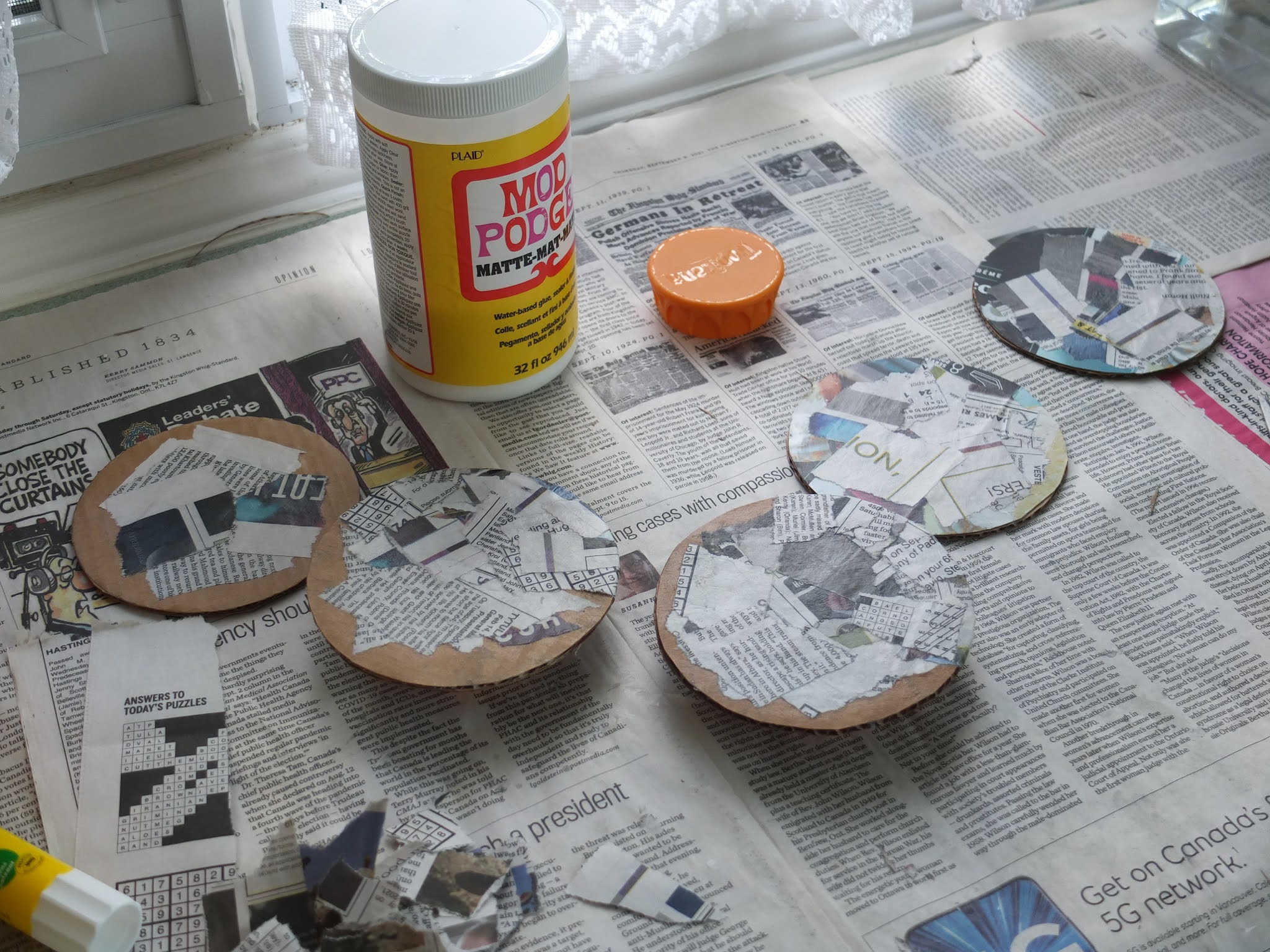
So, the Mod Podge Mache continues. I've got about three coats on I reckon, or close to it. I'm using Mod Podge - the "water-based glue, sealer and finish" by PLAID - instead of traditional paper mache. It seems to work fine, despite the "4 week cure time" mentioned on the tub. I just started my second 32 fl ox (946 ml) tub last night. So, between the amaTushane kopje, a few Zulu bases and this, that is how much paper mache I've done. The latest work has been to go around the edge and cover the base cardboard. I don't think I'm going to do underneath, though it might make it stronger if I did. (hmm...)

I've also been scrutinizing what photos I can find of Isandlwana before I tackle the upper bit; I didn't want to just go from a "mind's eye" impression. Unfortunately the period photos all seem to be from the same angle, or close to it. I'll just have to keep in mind that the more detailed modern photos reflect 140 years or so of wind and rain erosion. 

The plan is to cut the upper part down, both with vertical crevasses and possibly to shave a bit off the bulk. When I built it up I just sort of "winged it" and I might have over did it slightly. I'm away on the weekend so I'm not going to get back to it until late next week, but at least it'll be well dried by then.

Sunday, October 17, 2021

Isandlwana - the Impi Takes Shape


Zulu Movement Bases 
Still W.I.P.

Here are some "test bases" I did as a sort of "proof of concept". Each base is 100 scale meters across and represents 50-100 Zulu warriors. I was just trying to work out in my head if that density was reasonable...what's the formula again? I think that in close order, it is probably too low a ratio, but in open order - and I think the Zulus would be in a more open order - than I think perhaps it is not too unreasonable at the 1 base = 100 Zulus. What do you think?

That means 20 bases for a typical regiment. 

The bases start as the printed sheets, which I am printing on North American "Letter" sized paper (i.e. 8.5" x 11"). This because I am situated on the wrong side of the pond, and in Canada, while using the metric system we still use the same paper sizes as the USA. (Except, of course, for the work drawings I do which typically use ISO B1 sized paper (1000mm x 707mm). But that's Canada for you - a melting pot for everything, not just culture!

The process I've settled into is to print the sheets then mount them on a fine cardstock before cutting out the strips. I found that the paper I have isn't thick enough on its own. Maybe I am over compensating but it seems to work. The four paper layers and three layers of glue make for a pretty sturdy construct - provided I make sure I've got the glue properly distributed!


Sheets cut out and glued to fine cardstock.


One hour and ten minutes later... 
the strips ready for folding and gluing.

Then comes the cutting out!

Thursday, October 7, 2021

Isandlwana - Not Limited by the Counter Mix


Peter Dennis' Zulu War Paperboys


An Inventory...

Unlike many wargames, I am not "limited by the counter mix"! How can I when, if I need more, I can just print them? :-)

I decided to do an inventory.

Shown are approximately 1800 Zulus and an uncounted number of Imperial Forces. At 1:10 ratio that is more Zulus than I actually need as not all were engaged, and there won't be room for the entire right horn anyway. What is more important, however, is the proper proportion of shield colours. I'm still trying to sort that out. The colours are: Black, Black and White, White, Red, Red and White. Some regiments, like umCijo, need to be all black, but others can have a mix, or so I gather from my research. 

Regarding the British, my intent was to provide different bases for different formations and "States". So, extended order vs close order, etc. The "States" would be come into play when a section is broken up by contact with the Zulus, and are intended to show ever greater fragmentation and disorder. So, basically I need multiple bases for each company to show all of that. For the cavalry there are mounted and dismounted versions (including horse holders.)

Also, terrain building continues: amaTutshane.

Transformed from paper mache "hat", to "pudding" - as one friend dubbed it - to almost finished kopje.


"Hat"


"Pudding"
with Burnt Umber undercoat


Drybrushed with Raw Sienna


amaTutshane
Awaiting flocking...


Saturday, October 2, 2021

Isandlwana - a Small Update


Prone Zulus, taking cover from the British fire...


Casualty Markers


Zulu bases, in progress...


amaTutshane

A few things to report for this update. I've been snipping out figures for both the British and Zulus at a good rate, the casualties and prone figures shown being the easiest to do. The combatants are being worked on, but are not based yet.

The bases for the Zulus are going to be 120mm rounds which I have cut from corrugated cardboard. Being a bit paranoid about them warping I have been trying various things and recently realized that I needed to paper mache them to cover edges where the corrugated cardboard shows.

I've also been working on a couple of larger square or rectangular tents for the camp but not found a design I like yet.

I decided that my version of amaTutshane was too tall in relation to my version of Isandlwana itself so I have cut it down and trying to get the approximate shape right with paper mache. By my estimation it needs to be about 1/4 the height of Isandlwana

Tuesday, September 14, 2021

Isandlwana - The Camp Takes Shape


Left-to-Right: 1st/24th, Mtd & HQ, 2nd/24th, NNC, NNC,
wagon park on the nek.


Question: Where do the oxen and mules/horse go?

(They seem to get left off maps of the battlefield all the time!)

Sunday, September 12, 2021

Isandlwana - the Lower Storeys


The lower storeys take shape...


This is where the rock face ends...


 ...and the steep slopes begin.


The Eastern slopes, with that 
prominent knoll overlooking the nek.


The Western Slopes.

The next step: paper Mache!


The amaTutshane kopje, 
another prominent landmark on the battlefield.


Sunday, September 5, 2021

The Battle of Isandlwana: Some Battlefield Research


The Isandlwana Battlefield - via Google Maps

I am preparing to run a wargame version of Isandlwana later this month and have been doing some research to figure out how to set everything up. Luckily, a friend is allowing me to use his 6' x 15' table which, with the ground scale I've adopted works out at just about 4 kilometers. Google maps has a little measuring utility that allows me to measure and display that on the map, as shown above.


Isandlwana topo

Edit: ignore my tentative Chelmsford placement. 
I mistook the name of the hills. 
His force is down off the SE corner.

The University of Texas has a really good map library: 


This is The Perry-Castañeda Library (PCL) Map Collection. Apparently they have decided not to update it further and it was archived this year. Hopefully it will stick around as there are some really great maps there!

Anyway, I located a topographical map of South Africa and cobbled together the above image in PowerPoint. Comparing it to the Google satellite imagery one can see why it's reliability is only rated "fair"! Still it does give a rough idea where things were, and, more importantly for me, it gives me an estimate as to how high the ridgeline was. Going by the above map it is somewhere around 250 feet above the surrounding lowlands.

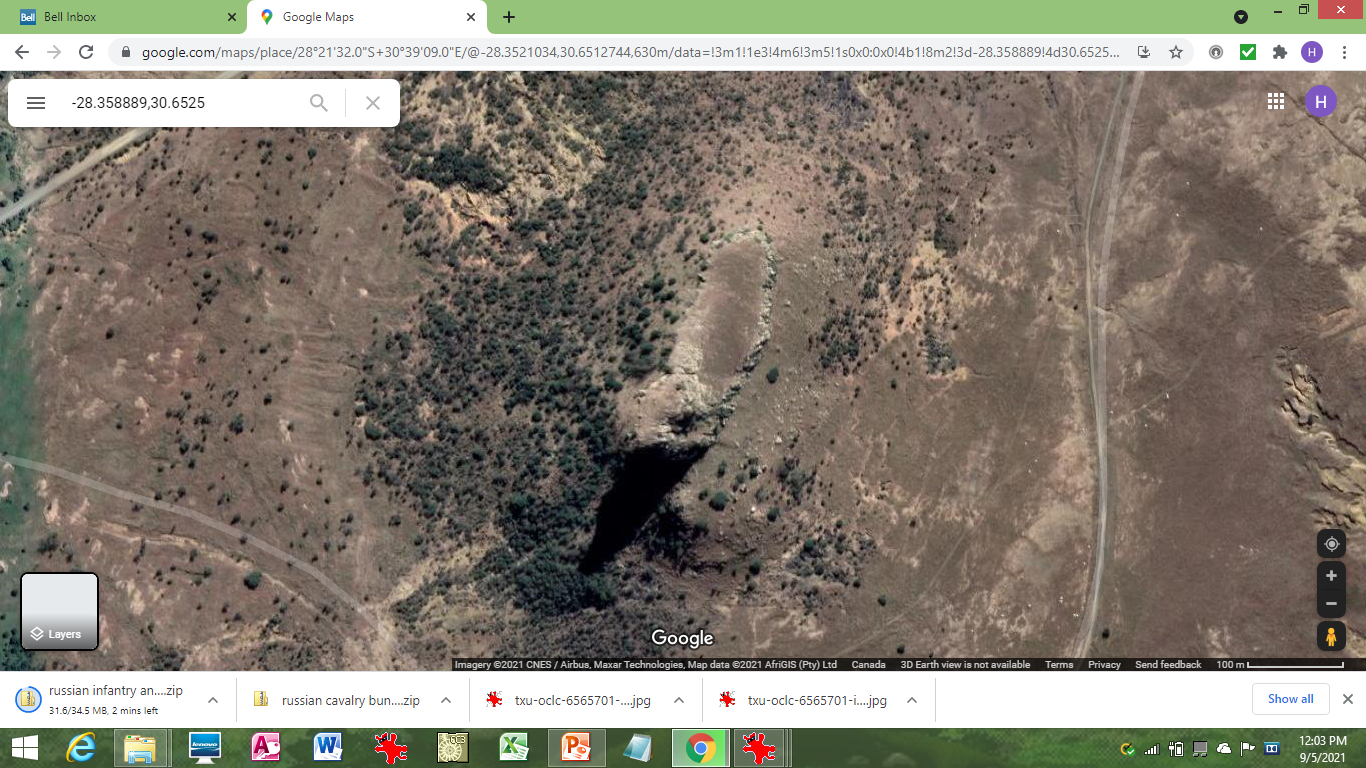
I'm still trying to work out how high the Isandlwana "mountain" is. It's not that large, actually. The footprint, I mean - see the image below. According to Google its only a couple of hundred meters long and less than 100 meters wide.


The above image shows a possible table layout. I realize now that my arrows for the Zulu Right Horn and Reserve are probably wrong. If the Right Horn was seen sweeping across Cavaye's front when his company was up on the ridge - and 600 yards to that front - then the sweep of the horn must have been much further westwards, leaving the map probably still on the ridge, then descending and doubling back. the end of their arrow would have been moving eastwards over the gap.

More to follow...